The field of vision has always seemed to me comparable to the ground of an archaeological excavation.
- Paul Virilio
Sunday, 26 February 2012
Mr Jozef Smole, the head of the Slovene Socialist Alliance, accused Mr Milosevic of 'pouring manure' on Slovenia in a speech that portended a Serbian 'crusade' against the northern republic, widely viewed as the most liberal part of the country. 'I am deeply offended,' said Mr Smole. 'One would not expect the president of Serbia to lower himself to such slander.'
- Ian Traynor from Vienna, in The Guardian, 25th May, 1989
- Ian Traynor from Vienna, in The Guardian, 25th May, 1989
Wednesday, 22 February 2012
Tuesday, 21 February 2012
It is undeniable, however, that foreign influence in the forms of militarism and tourism has played a very prominent role during the past few decades in making prostitution a prominent industry in Thailand.
- Sinith Sittirak
"It's the last place in the world where you can still be a white man"
(German bar owner resident in Thailand.)
- Sinith Sittirak
"It's the last place in the world where you can still be a white man"
(German bar owner resident in Thailand.)
Monday, 20 February 2012
Mr Corbett disclaimed having started anything new. The sanctuary movement had been around for more than 3,000 years, he said, strengthening or fading according to the demands of the time. As the countries south of the United States border have become less brutal, the movement has faded. In Europe, the widespread hostility to those seeking asylum from countries as far away as China and Afghanistan has touched some consciences, perhaps presaging another sanctuary movement. But a new Jim Corbett has yet to emerge to speak of the unity of humanity and such unpopular themes.

Thursday, 16 February 2012
Saturday, 11 February 2012
Evening 11th April, 2003:
a pair of RAF CH47 Chinook helicopters swept over Iraq's western desert towards a remote rendezvous point beside Route 10, the highway that begins life on the outskirts of Baghdad before running for mile after mile towards the border with Jordan...The helicopter crews had been told that a number of detainees were under armed guard at the side of the highway. They were to pick them up after dark and take them to a prison camp. What followed was far from routine: before the night was out, one man had died on board one of the helicopters, allegedly beaten to death by RAF personnel.
[...]
By the time the helicopters had reached their destination, two of the prisoners "were found to be unresponsive", according to the squadron leader, while "there was some commotion at the front of the aircraft" because a third prisoner, a disabled man, had somehow parted company with both his prosthetic legs.
here.
a pair of RAF CH47 Chinook helicopters swept over Iraq's western desert towards a remote rendezvous point beside Route 10, the highway that begins life on the outskirts of Baghdad before running for mile after mile towards the border with Jordan...The helicopter crews had been told that a number of detainees were under armed guard at the side of the highway. They were to pick them up after dark and take them to a prison camp. What followed was far from routine: before the night was out, one man had died on board one of the helicopters, allegedly beaten to death by RAF personnel.
[...]
By the time the helicopters had reached their destination, two of the prisoners "were found to be unresponsive", according to the squadron leader, while "there was some commotion at the front of the aircraft" because a third prisoner, a disabled man, had somehow parted company with both his prosthetic legs.
here.
Friday, 10 February 2012
Once upon a time there was a river which flowed into another river which one day men would call the Rhine. But in those days there were no men, no names and no North Sea and no island called Great Britain and the only beings who knew this river which flowed into the nameless Rhine were the fishes which swam up and down it
- Graham Swift, 15. About the Ouse, 'Waterland'
- Graham Swift, 15. About the Ouse, 'Waterland'
Sunday, 5 February 2012
The last speaker of an ancient language in India's Andaman Islands has died at the age of about 85, a leading linguist has told the BBC.
The death of the woman, Boa Senior, was highly significant because one of the world's oldest languages, Bo, had come to an end, Professor Anvita Abbi said.
She said that India had lost an irreplaceable part of its heritage.
about two years gone
The death of the woman, Boa Senior, was highly significant because one of the world's oldest languages, Bo, had come to an end, Professor Anvita Abbi said.
She said that India had lost an irreplaceable part of its heritage.
about two years gone
Friday, 3 February 2012

chasing the wrong priority
Back to front: Jennifer Rubin in the WaPo with her appending of Polisario and Western Sahara to a laundry list of Islamist grievance.
obviously, what else should we expect from Rubin? fair rejoinder. i have no answer.
a quote from her own column, though, lights the way.
i mean, really.
here we are.
fixed that for ya.
also: Polisario bundled with AQIM.
yeah?
i mean.
Andrew Lebovich: "Ask yourself why only b-siders and Rubin talk so much abt the Polisario and terrorism in North Africa"
Thursday, 2 February 2012
harsh employer employee relations (coercion, punitive) in the informal economy
in the wider setting of racialised structural inequality *
(see chapter 4 of Sen's Development as Freedom for discussion of the higher death rates for African-Americans over white Americans, adjusted for income factors, and certainly not just in the category of violent deaths of young males, but all men and women, "more explanation is needed than violent deaths can provide".)
great scene
technical side-note: in the question of British and Irish actors enjoying major roles in The Wire the American accent that Idris Elba (above) takes off is some way better than that of Dominic West's plod McNulty, or Aidan Gillen's city pol Tommy Carcetti
* this would be news to Newt Gingrich, who completely elides structural racialised inequality and deprivation in his native USA in his analyses of individuals and the market
in the wider setting of racialised structural inequality *
(see chapter 4 of Sen's Development as Freedom for discussion of the higher death rates for African-Americans over white Americans, adjusted for income factors, and certainly not just in the category of violent deaths of young males, but all men and women, "more explanation is needed than violent deaths can provide".)
great scene
technical side-note: in the question of British and Irish actors enjoying major roles in The Wire the American accent that Idris Elba (above) takes off is some way better than that of Dominic West's plod McNulty, or Aidan Gillen's city pol Tommy Carcetti
* this would be news to Newt Gingrich, who completely elides structural racialised inequality and deprivation in his native USA in his analyses of individuals and the market
Tuesday, 31 January 2012
one current obsession. (appropriate to pathologise ardent pre-occupations with 'obsessive'? flip side: aged 32, grow up and find that measured middle ground? flip flip side: stop constructing deliberate binaries you cheap cunt, the stock-in-trade of the water cooler pseud. this all in inverted commas, right?)
anyway.
opening 40 seconds or so of this track from the American band Tennis (in particular, though the song in general hits me in the mush), from their 2011 album Cape Dory; this is the title track.
pregnant possibility, wonderful guitar lines of Patrick Riley augmenting Alaina Moore's language of promise and intent, anchoring everything as she forms worlds, then along comes James Barone, fuller this time, to his kit, love it love it love it.
anyway.
opening 40 seconds or so of this track from the American band Tennis (in particular, though the song in general hits me in the mush), from their 2011 album Cape Dory; this is the title track.
pregnant possibility, wonderful guitar lines of Patrick Riley augmenting Alaina Moore's language of promise and intent, anchoring everything as she forms worlds, then along comes James Barone, fuller this time, to his kit, love it love it love it.
Monday, 30 January 2012
Wiki: (with bibliography)
King Philip's War, sometimes called the First Indian War, Metacom's War, Metacomet's War, or Metacom's Rebellion, was an armed conflict between Native American inhabitants of present-day southern New England and English colonists and their Native American allies in 1675–76. The war is named after the main leader of the Native American side, Metacomet, known to the English as "King Philip"
[...]
According to a combined estimate of loss of life in Schultz and Tougias' King Philip's War, The History and Legacy of America's Forgotten Conflict (based on sources from the Department of Defense, the Bureau of Census, and the work of colonial historian Francis Jennings), 600 out of the about 80,000 English colonists (1.5%) and 3,000 out of 10,000 Native Americans (30%) lost their lives due to the war.
King Philip's War, sometimes called the First Indian War, Metacom's War, Metacomet's War, or Metacom's Rebellion, was an armed conflict between Native American inhabitants of present-day southern New England and English colonists and their Native American allies in 1675–76. The war is named after the main leader of the Native American side, Metacomet, known to the English as "King Philip"
[...]
According to a combined estimate of loss of life in Schultz and Tougias' King Philip's War, The History and Legacy of America's Forgotten Conflict (based on sources from the Department of Defense, the Bureau of Census, and the work of colonial historian Francis Jennings), 600 out of the about 80,000 English colonists (1.5%) and 3,000 out of 10,000 Native Americans (30%) lost their lives due to the war.
Sunday, 29 January 2012
There was a little city, and few men within it; and there came a great king against it, and besieged it, and built great bulwarks against it;
Now there was found in it a poor wise man, and he by his wisdom delivered the city; yet no man remembered that same poor man. Then said I, Wisdom is better than strength: nevertheless the poor man's wisdom is despised, and his words are not heard.
- Ecclesiastes 9: 14-16
Now there was found in it a poor wise man, and he by his wisdom delivered the city; yet no man remembered that same poor man. Then said I, Wisdom is better than strength: nevertheless the poor man's wisdom is despised, and his words are not heard.
- Ecclesiastes 9: 14-16
Saturday, 28 January 2012
The settler's town is a strongly-built town, all made of stone and steel. It is a brightly-lit town; the streets are covered with asphalt, and the garbage-cans swallow all the leavings, unseen, unknown and hardly thought about.
The settler's feet are never visible, except perhaps in the sea; but there you've never close enough to see them. His feet are protected by strong shoes although the streets of his town are clean and even, with no holes or stones.
The settler's town is a well-fed town, an easy-going town; its belly is always full of good things. The settler's town is a town of white people, of foreigners.
The town belonging to the colonized people, or at least the native town, the Negro village, the medina, the reservation, is a place of ill fame, peopled by men of evil repute. They are born there, it matters little where or how; they die there, it matters not where, nor how. It is a world without spaciousness; men live there on top of each other, and their huts are built one on top of the other.
The native town is a hungry town, starved of bread, of meat, of shoes, of coal, of light. The native town is a crouching village, a town on its knees, a town wallowing in the mire. It is a town of n*****s and dirty arabs.
- Frantz Fanon, 1961
The settler's feet are never visible, except perhaps in the sea; but there you've never close enough to see them. His feet are protected by strong shoes although the streets of his town are clean and even, with no holes or stones.
The settler's town is a well-fed town, an easy-going town; its belly is always full of good things. The settler's town is a town of white people, of foreigners.
The town belonging to the colonized people, or at least the native town, the Negro village, the medina, the reservation, is a place of ill fame, peopled by men of evil repute. They are born there, it matters little where or how; they die there, it matters not where, nor how. It is a world without spaciousness; men live there on top of each other, and their huts are built one on top of the other.
The native town is a hungry town, starved of bread, of meat, of shoes, of coal, of light. The native town is a crouching village, a town on its knees, a town wallowing in the mire. It is a town of n*****s and dirty arabs.
- Frantz Fanon, 1961
Thursday, 26 January 2012
Tuesday, 24 January 2012
Sunday, 22 January 2012
Friday, 20 January 2012
FROM THE MOMENT I HEARD about Bidder #70 raising his paddle inside a BLM auction to outbid oil and gas companies in the leasing of Utah’s public lands, I recognized Tim DeChristopher as a brave, creative citizen-activist. That was on December 19, 2008, in Salt Lake City. Since that moment, Tim has become a thoughtful, dynamic leader of his generation in the climate change movement. While many of us talk about the importance of democracy, Tim has put his body on the line and is now paying the consequences.
here
(via.)
here
(via.)
Wednesday, 18 January 2012
re-up and a broadcast over a year old now, but the Radio 4 programme Cambodia: Country for Sale is apposite listening set alongside the post here yesterday
Tuesday, 17 January 2012
The Ethiopian government under its “villagization” program is forcibly relocating approximately 70,000 indigenous people from the western Gambella region to new villages that lack adequate food, farmland, healthcare, and educational facilities...State security forces have repeatedly threatened, assaulted, and arbitrarily arrested villagers who resist the transfers.
[...]
The villagization program is taking place in areas where significant land investment is planned or occurring. The Ethiopian government has consistently denied that the resettlement of people in Gambella is connected to the leasing of large areas of land for commercial agriculture, but villagers have been told by government officials that this is an underlying reason for their displacement. Former local government officials confirmed these allegations to Human Rights Watch.
One farmer told Human Rights Watch that during the government’s initial meeting with his village, government officials told them: “We will invite investors who will grow cash crops. You do not use the land well. It is lying idle.”
[...]
From 2008 through January 2011, Ethiopia leased out at least 3.6 million hectares of land, an area the size of the Netherlands. An additional 2.1 million hectares of land is available through the federal government’s land bank for agricultural investment. In Gambella, 42 percent of the total land area is either being marketed for lease to investors or has already been awarded to investors, according to government figures. Many of the areas that have been moved for villagization are within areas slated for commercial agricultural investment.
“The government is killing our people through starvation and hunger. It is better to attack us in one place than just waiting here together to die. If you attack us, some of us could run, and some could survive. But this, we are dying here with our children. Government workers get this salary, but we are just waiting here for death.”
–Elder in recently relocated village, Abobo woreda, May 2011
“There is a psychological impact on children. No learning is happening. There was a school in the old village, here there is none. No one is going to school now, as they are afraid. Who will protect them going to the old village? Even the children themselves are refusing to go.”
–Anuak woman from new village discussing the lack of promised school in Abobo woreda, May 2011
(re: land, see also)
[...]
The villagization program is taking place in areas where significant land investment is planned or occurring. The Ethiopian government has consistently denied that the resettlement of people in Gambella is connected to the leasing of large areas of land for commercial agriculture, but villagers have been told by government officials that this is an underlying reason for their displacement. Former local government officials confirmed these allegations to Human Rights Watch.
One farmer told Human Rights Watch that during the government’s initial meeting with his village, government officials told them: “We will invite investors who will grow cash crops. You do not use the land well. It is lying idle.”
[...]
From 2008 through January 2011, Ethiopia leased out at least 3.6 million hectares of land, an area the size of the Netherlands. An additional 2.1 million hectares of land is available through the federal government’s land bank for agricultural investment. In Gambella, 42 percent of the total land area is either being marketed for lease to investors or has already been awarded to investors, according to government figures. Many of the areas that have been moved for villagization are within areas slated for commercial agricultural investment.
“The government is killing our people through starvation and hunger. It is better to attack us in one place than just waiting here together to die. If you attack us, some of us could run, and some could survive. But this, we are dying here with our children. Government workers get this salary, but we are just waiting here for death.”
–Elder in recently relocated village, Abobo woreda, May 2011
“There is a psychological impact on children. No learning is happening. There was a school in the old village, here there is none. No one is going to school now, as they are afraid. Who will protect them going to the old village? Even the children themselves are refusing to go.”
–Anuak woman from new village discussing the lack of promised school in Abobo woreda, May 2011
(re: land, see also)
Sunday, 15 January 2012
Stop and search 'racial profiling' by police on the increase, claims study
Analysis shows that black people are now 30 times more likely to be stopped by the police than white people
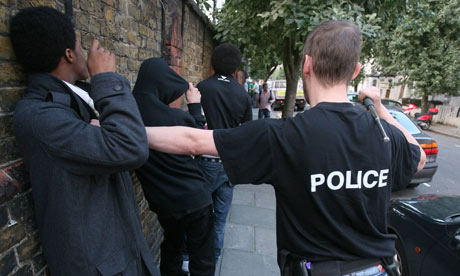
Police perform a stop and search procedure on a group of young people in London.
Photograph: Jason Alden / Rex Features
Analysis shows that black people are now 30 times more likely to be stopped by the police than white people
Police perform a stop and search procedure on a group of young people in London.
Photograph: Jason Alden / Rex Features
Saturday, 14 January 2012
Tuesday, 10 January 2012
they stopped it
since he has been in power in Rwanda, Kagame has been responsible for many abuses.
that is fact.
(Rwanda may actually even be responsible for genocide - or crimes approaching the threshold of genocide - in the neighbouring DRC.)
however, none of this changes the central fact of the genocide in Rwanda in 1994, and who is to blame for the genocide; granted, you do get fruitloops attempting to totally invert what happened there, usually for their own agenda, which has nothing to do with the people of Rwanda.
referencing the latest report into the matter (there have been others), earlier today Oliver tweeted a very, very important point to remember.
Remember: the genocide was a Hutu Power plot and the RPF did not start it, they stopped it, and no one else was going to do that.
"they stopped it, and no else was going to do that".
that is the central point.
it is how the Rwandan genocide was stopped when it was stopped, instead of continuing until it stopped.
this is the central point.
it is the only point.
and no else was going to do that
since he has been in power in Rwanda, Kagame has been responsible for many abuses.
that is fact.
(Rwanda may actually even be responsible for genocide - or crimes approaching the threshold of genocide - in the neighbouring DRC.)
however, none of this changes the central fact of the genocide in Rwanda in 1994, and who is to blame for the genocide; granted, you do get fruitloops attempting to totally invert what happened there, usually for their own agenda, which has nothing to do with the people of Rwanda.
referencing the latest report into the matter (there have been others), earlier today Oliver tweeted a very, very important point to remember.
Remember: the genocide was a Hutu Power plot and the RPF did not start it, they stopped it, and no one else was going to do that.
"they stopped it, and no else was going to do that".
that is the central point.
it is how the Rwandan genocide was stopped when it was stopped, instead of continuing until it stopped.
this is the central point.
it is the only point.
and no else was going to do that
Saturday, 7 January 2012
A further 800,000 homes will be put out of reach of people on housing benefit because of government welfare cuts – leaving low income families the choice of cutting spending on food to pay the rent or moving out, according to a study by housing experts.
[...]
It is unlikely that the poor will be able migrate to cheaper parts of the capital: in Newham, east London, there will be twice as many claimants as there are low-cost homes. In Croydon, 17,000 people will be chasing 10,000 properties.
The effect will be felt not just in south-east England. Before today, Birmingham had more than 37,000 homes with rents affordable on welfare. Now 34,500 housing benefit claimants will be chasing 23,000 low-cost houses, according to the analysis, carried out for the Guardian. On the Mersey, 21,000 people collecting local housing allowance will only be able to afford 12,000 homes in Liverpool.
Because welfare is set at Westminster, the cuts will also be felt in Scotland. In Glasgow there will be a thousand more benefit recipients than there are properties which can be rented with the government's reduced housing subsidy.
Class war in Britain in 2012.
[...]
It is unlikely that the poor will be able migrate to cheaper parts of the capital: in Newham, east London, there will be twice as many claimants as there are low-cost homes. In Croydon, 17,000 people will be chasing 10,000 properties.
The effect will be felt not just in south-east England. Before today, Birmingham had more than 37,000 homes with rents affordable on welfare. Now 34,500 housing benefit claimants will be chasing 23,000 low-cost houses, according to the analysis, carried out for the Guardian. On the Mersey, 21,000 people collecting local housing allowance will only be able to afford 12,000 homes in Liverpool.
Because welfare is set at Westminster, the cuts will also be felt in Scotland. In Glasgow there will be a thousand more benefit recipients than there are properties which can be rented with the government's reduced housing subsidy.
Class war in Britain in 2012.
Friday, 6 January 2012
Thursday, 5 January 2012
Sunday, 1 January 2012
The Elizabethan legislation was intended to help the 'settled' poor who found themselves out of work (for example) because of illness, or during a hard winter or a trade depression. It was assumed that these people would accept whatever work or relief the parish offered, whether that was indoor or outdoor relief. Neither method of assistance was seen as punitive or harsh. It was intended to deter or deal with the 'sturdy beggars' who were roaming the roads, robbing travellers and generally posing a threat to civil order. The increase in the numbers of beggars was probably the historical background to the nursery rhyme
Hark! Hark! The dogs do bark!
The beggars are coming to town:
Some in rags, some in tags
And one in a velvet gown
The 1601 Elizabethan Poor Law
The beggars are coming to town:
Some in rags, some in tags
And one in a velvet gown
The 1601 Elizabethan Poor Law
Saturday, 31 December 2011
2011
- I Know Something About Love :
group show with Shirin Neshat, Christodoulos Panayiotou, Yinka Shonibare and Yang Fudong,
Parasol unit
- L and i had problems with how in Neshat's video on forbidden love (snatched glances across Iranian prayer rooms, women firmly in a post-Revolution cage) the woman was fairly heavily made up beneath her cloths, and the bloke was a bit of a conventional oil painting, foregrounded in a sea of anonymous, unadorned faces *, but the cumulative effect of that, of Yang's inquiring video as young Chinese brazenly discuss their relationships, of Shonibare's (admittedly well-worked, if one-trick **) texture-heavy riff on Rococo France that had you scampering around a delicious trellis maze, all the while as elsewhere the slow dance marathon Cypriots in Panayiotou's video charmed pants off bemused viewers, was certainly enough.
(incidentally - the garden and pond at the back of Parasol Unit lovely.)
* is this a 'correct' response? who knows?
** this was more of a problem for the experienced L than myself, given i was popping my Shonibare cherry
Anselm Kiefer: Des Meeres und der Liebe Wellen, White Cube Hoxton Square - signature gigantic seascapes (everything comes from there) that battered faculties into submission; could have stayed beaten for days
- Chantal Joffe, Victoria Miro - portraits to push it forward
- Richard Long and Giuseppe Penone, Haunch of Venison - the complementarity of both (love 'em both, never seen 'em together before)
- Twombly and Poussin: Arcadian Painters, Dulwich Picture Gallery - all of this made sense
Look11 Photography Festival (website), Liverpool, various venues
(including that fabulous resource the Contemporary Urban Centre on Greenland Street, and the splendid Blue Coat School)
- what to mention in scraps? Paul Graham's portraits of Thatcherite dole offices, Mohamed Bourouissa's staged neo-classical-like banlieue series Peripheriques, the group show Collateral Damage, with the likes of Tim Hetherington (RIP), horribly clear-eyed in Sierra Leone, the bedrooms of young American soldiers KIA, preserved in time by grieving parents, documents of American bases worldwide, dry schematic presentations, Edmund Clark's incredibly distressing series from Gitmo, Dornith Doherty photographing seed banks, Juergen Chill’s mundane German prisons: lots and lots of containerisation, confinement benign and otherwise
(quite literally for attendants of the off-off site installations of TRANSITION: fine work - Ciara Leeming on representations and "what it means to be a Gypsy/Traveller in the UK in the 21st century", or listen to Gary Tack here This piece is a kind of photo essay of my old city's attempt at transition architecturally, socially and economically with this theme running throughout the image. It is a reminder to the viewer that Liverpool was and remains, fundamentally, a working class city that is now dysfunctional. It’s original reasons for existence have been lost and the still extant historical attitudes of its mainly working class inhabitants remain despite their urban identity being lost because of the changes forced upon them - pasted on to shipping containers; being locked inside those not something to be forgotten in a hurry)
- Bridget Riley: Paintings and Related Work, National Gallery's Sunley Room - fundamental
(the work displayed from when she was a teen - her van Eyck copy of his Man in a Red Turban, which was news to me - felt like being on the precipice of a paradigm shift, but then you realised it already happened; does this hymning mean genius > scenius? hrm. wind-flecked Cornish coastal grasses, Egyptian blue, Ad Reinhardt, you know ALL THAT CROWD)
- Eyewitness: Hungarian Photography in the 20th Century, Royal Academy - it will suffice to list names: Brassaï, Capa, Kertész, Moholy-Nagy, Munkácsi.
"Others, such as Károly Escher, Rudolf Balogh and Jószef Pécsi".
peerless.
- Modern British Sculpture, Royal Academy - the curating was deliberately all over the shop; hence i thought 'fucking brilliant'
- I Know Something About Love :
group show with Shirin Neshat, Christodoulos Panayiotou, Yinka Shonibare and Yang Fudong,
Parasol unit
- L and i had problems with how in Neshat's video on forbidden love (snatched glances across Iranian prayer rooms, women firmly in a post-Revolution cage) the woman was fairly heavily made up beneath her cloths, and the bloke was a bit of a conventional oil painting, foregrounded in a sea of anonymous, unadorned faces *, but the cumulative effect of that, of Yang's inquiring video as young Chinese brazenly discuss their relationships, of Shonibare's (admittedly well-worked, if one-trick **) texture-heavy riff on Rococo France that had you scampering around a delicious trellis maze, all the while as elsewhere the slow dance marathon Cypriots in Panayiotou's video charmed pants off bemused viewers, was certainly enough.
(incidentally - the garden and pond at the back of Parasol Unit lovely.)
* is this a 'correct' response? who knows?
** this was more of a problem for the experienced L than myself, given i was popping my Shonibare cherry
Anselm Kiefer: Des Meeres und der Liebe Wellen, White Cube Hoxton Square - signature gigantic seascapes (everything comes from there) that battered faculties into submission; could have stayed beaten for days
- Chantal Joffe, Victoria Miro - portraits to push it forward
- Richard Long and Giuseppe Penone, Haunch of Venison - the complementarity of both (love 'em both, never seen 'em together before)
- Twombly and Poussin: Arcadian Painters, Dulwich Picture Gallery - all of this made sense
Look11 Photography Festival (website), Liverpool, various venues
(including that fabulous resource the Contemporary Urban Centre on Greenland Street, and the splendid Blue Coat School)
- what to mention in scraps? Paul Graham's portraits of Thatcherite dole offices, Mohamed Bourouissa's staged neo-classical-like banlieue series Peripheriques, the group show Collateral Damage, with the likes of Tim Hetherington (RIP), horribly clear-eyed in Sierra Leone, the bedrooms of young American soldiers KIA, preserved in time by grieving parents, documents of American bases worldwide, dry schematic presentations, Edmund Clark's incredibly distressing series from Gitmo, Dornith Doherty photographing seed banks, Juergen Chill’s mundane German prisons: lots and lots of containerisation, confinement benign and otherwise
(quite literally for attendants of the off-off site installations of TRANSITION: fine work - Ciara Leeming on representations and "what it means to be a Gypsy/Traveller in the UK in the 21st century", or listen to Gary Tack here This piece is a kind of photo essay of my old city's attempt at transition architecturally, socially and economically with this theme running throughout the image. It is a reminder to the viewer that Liverpool was and remains, fundamentally, a working class city that is now dysfunctional. It’s original reasons for existence have been lost and the still extant historical attitudes of its mainly working class inhabitants remain despite their urban identity being lost because of the changes forced upon them - pasted on to shipping containers; being locked inside those not something to be forgotten in a hurry)
- Bridget Riley: Paintings and Related Work, National Gallery's Sunley Room - fundamental
(the work displayed from when she was a teen - her van Eyck copy of his Man in a Red Turban, which was news to me - felt like being on the precipice of a paradigm shift, but then you realised it already happened; does this hymning mean genius > scenius? hrm. wind-flecked Cornish coastal grasses, Egyptian blue, Ad Reinhardt, you know ALL THAT CROWD)
- Eyewitness: Hungarian Photography in the 20th Century, Royal Academy - it will suffice to list names: Brassaï, Capa, Kertész, Moholy-Nagy, Munkácsi.
"Others, such as Károly Escher, Rudolf Balogh and Jószef Pécsi".
peerless.
- Modern British Sculpture, Royal Academy - the curating was deliberately all over the shop; hence i thought 'fucking brilliant'
Friday, 30 December 2011
Mr Stewart says the project is largely designed to bring scripture alive, but it also has another important function - to rescue patois from its second-class status in Jamaica and to enshrine it as a national language.
their verbal communication is demeaned as vernacular chatter on this side but elevated as linguistic discourse on the other
- Mamdani, 1996.
their verbal communication is demeaned as vernacular chatter on this side but elevated as linguistic discourse on the other
- Mamdani, 1996.

Wednesday, 28 December 2011
Tuesday, 27 December 2011
and in some of my other favourites from this year, Mike Skinner's mix for FACT (link) has cracking selections all the way through, but i especially appreciate at the end a jungle do-over of Bjork that finishes beautifully, bringing the melancholic 4am come down to you, switching into the shimmering, gorgeous build-up of corking Canadian prog house, that and perhaps how he goes into Jean Jacques Smoothie near the start
Monday, 26 December 2011
Sunday, 25 December 2011
The approach of entitlements used in this work is very general and - I would argue - quite inescapable in analysing starvation and poverty. If, nevertheless, it appears odd and unusual, this can be because of the hold of the tradition of thinking in terms of what exists rather than in terms of who can command what. The mesmering simplicity of focusing on the ratio of food to population has persistently played an obscuring role over centuries, and continues to plague policy discussions today much as it has deranged anti-famine policies in the past.
- Amartya Sen, 1982
- Amartya Sen, 1982
Thursday, 22 December 2011

Wednesday, 21 December 2011
HRW: 'This 52-page report documents the effect of the Beason-Hammon Alabama Taxpayer Citizen and Protection Act, commonly known as HB 56, on unauthorized immigrants and their families, as well as the larger Alabama communities in which they live. It is based in part on first-hand accounts by 57 Alabama residents, including citizens and permanent residents, who reported abuse or discrimination under the law.'
a real fucking cunt of a bill.
a real fucking cunt of a bill.
Tuesday, 20 December 2011
from the courageous and invaluable Bahrain Center for Human Rights
Police in Bahrain on Sunday fired tear gas at thousands of demonstrators chanting anti-government slogans after the funeral of an elderly man who witnesses say died from tear gas inhalation.
The unrest Sunday is the fourth straight day of clashes between opposition supporters and security forces along a main highway west of the Bahraini capital Manama. At least 40 people have been killed since February, when Bahrain's Shiite majority started campaigning for more rights from Sunni rulers in the Gulf kingdom that is the home of the U.S. Navy's 5th Fleet.
Amir al-Mouali said his 73-year-old neighbor, Abdulali Ali Ahmed, was taken to a hospital Saturday morning after struggling to breath during a night of heavy clashes near his home along the Budaiya highway, which connects a string of Shiite villages west of Manama. Al-Mouali said Ahmed died Saturday evening.
In a statement Sunday, Bahrain's Interior Ministry said Ahmed died of natural causes.
- AP.
Bahraini security forces use tear gas made in the USA, France and Brazil.
can you have a dialogue with tear gas?
Police in Bahrain on Sunday fired tear gas at thousands of demonstrators chanting anti-government slogans after the funeral of an elderly man who witnesses say died from tear gas inhalation.
The unrest Sunday is the fourth straight day of clashes between opposition supporters and security forces along a main highway west of the Bahraini capital Manama. At least 40 people have been killed since February, when Bahrain's Shiite majority started campaigning for more rights from Sunni rulers in the Gulf kingdom that is the home of the U.S. Navy's 5th Fleet.
Amir al-Mouali said his 73-year-old neighbor, Abdulali Ali Ahmed, was taken to a hospital Saturday morning after struggling to breath during a night of heavy clashes near his home along the Budaiya highway, which connects a string of Shiite villages west of Manama. Al-Mouali said Ahmed died Saturday evening.
In a statement Sunday, Bahrain's Interior Ministry said Ahmed died of natural causes.
- AP.
Bahraini security forces use tear gas made in the USA, France and Brazil.
can you have a dialogue with tear gas?
Sunday, 18 December 2011
Friday, 16 December 2011
London schoolchildren among those taking to the streets to protest the likely rigged election in the DRC and general lack of outside interest in Congolese woes (this precisely aligns with the international community's systematic plundering of Congolese treasure, naturally),
earlier this month.
i hadn't followed what UK press coverage of these hugely under-reported protests there has been, but apparently what few items have tended to crop up in the UK media have focused on London tourists being inconvenienced (maybe some Christmas shoppers too, i daresay! heavens), which is both absolutely sickening and, of course, not a surprise in the slightest when you take into account the (for the most part) ridiculous shower that passes for an enquiring press in the UK

earlier this month.
i hadn't followed what UK press coverage of these hugely under-reported protests there has been, but apparently what few items have tended to crop up in the UK media have focused on London tourists being inconvenienced (maybe some Christmas shoppers too, i daresay! heavens), which is both absolutely sickening and, of course, not a surprise in the slightest when you take into account the (for the most part) ridiculous shower that passes for an enquiring press in the UK
Sunday, 11 December 2011
networks
neoliberalism
neoliberal networks
Intensive globalization has been created largely by law firms and more specialised financial services. As a process it can be interpreted as indicating globalization's origins in mid-twentieth century Americanization. As an outcome it can be interpreted as a continuing core of the globalization process.
Extensive globalization has been created largely by accountancy and advertising firms. As a process it can be interpreted as the diffusion of globalization from its Americanization origins. As an outcome it can be interpreted as the worldwide incorporation of cities into globalization.
see

neoliberalism
neoliberal networks
Intensive globalization has been created largely by law firms and more specialised financial services. As a process it can be interpreted as indicating globalization's origins in mid-twentieth century Americanization. As an outcome it can be interpreted as a continuing core of the globalization process.
Extensive globalization has been created largely by accountancy and advertising firms. As a process it can be interpreted as the diffusion of globalization from its Americanization origins. As an outcome it can be interpreted as the worldwide incorporation of cities into globalization.
see
Saturday, 10 December 2011
Hitchens concludes the essay with the observation that even as he was writing the article, he noticed a full-page advertisement from CAMERA [Committee for Accuracy in Middle East Reporting in America], which said:
In 1948, on the day of the proclamation of the State of Israel, five Arab armies invaded the new country from all sides. In frightful radio broadcasts, they urged the Arabs living there to leave, so that the invading armies could operate without interference.
Hitchens says he wrote to CAMERA on 20 February 1987, asking for an authenticated case of such a broadcast. He did not receive any reply. And he concludes with a prediction:
Even though nobody has ever testified to having heard them, and even though no record of their transmission has ever been found, we shall hear of these orders and broadcasts again and again.
Hitchens says he wrote to CAMERA on 20 February 1987, asking for an authenticated case of such a broadcast. He did not receive any reply. And he concludes with a prediction:
Tuesday, 6 December 2011
Sunday, 4 December 2011
Barbed wire and burnt-out vehicles, trucks laden with logs splayed across the roads, stone-throwing mobs and panicking international peacekeepers cowering behind their riot shields. The Balkan checkpoint, wearily familiar from the Yugoslav wars of the 1990s, is back.
In an attempt to keep a little swath of Kosovo Serbian, Serbs have cut roads, blocked passages and erected checkpoints at a score of locations across the north of Kosovo bordering Serbia since the summer.
oh dear.
Europe and Serbia are engaged in a risky game of brinkmanship. On the dusty blocked roads of northern Kosovo, Serbia's future is at stake.
In an attempt to keep a little swath of Kosovo Serbian, Serbs have cut roads, blocked passages and erected checkpoints at a score of locations across the north of Kosovo bordering Serbia since the summer.
oh dear.
Europe and Serbia are engaged in a risky game of brinkmanship. On the dusty blocked roads of northern Kosovo, Serbia's future is at stake.

Thursday, 24 November 2011
Average pay in the City of London has jumped by 12% to £83,000 in the last year, with managing directors enjoying a 21% increase to £237,000, a new report said today.
source: London Evening Standard, Monday 21st November 2011
source: London Evening Standard, Monday 21st November 2011
Saturday, 19 November 2011
Wednesday, 9 November 2011
Monday, 7 November 2011
So when US analysts or European journalists or World Bank bureaucrats ruminate about "when will there be a Palestinian spring?", it's generally because they have no historical context, no idea that Palestine's first intifada spring in many ways set the stage for this Arab spring more than two decades later.
here
here
Friday, 4 November 2011
Thursday, 3 November 2011

Monday, 31 October 2011
Sunday, 30 October 2011
Thursday, 27 October 2011
Sunday, 16 October 2011
Sunday, 9 October 2011
Tuesday, 4 October 2011
Wednesday, 28 September 2011
one of the great blogs is no more.
cheers Graeme.
i'm going to re-up a David Harvey quote this blog has borrowed once before, first from Graeme's site; it seems appropriate.
My view is that [neoliberalism] refers to a class project that coalesced in the crisis of the 1970s. Masked by a lot of rhetoric about individual freedom, liberty, personal responsibility and the virtues of privatisation, the free market and free trade, it legitimised draconian policies designed to restore and consolidate capitalist class power. This project has been successful, judging by the incredible centralisation of wealth and power observable in all those countries that took the neoliberal road. And there is no evidence that it is dead.
- The Enigma of Capital and the Crises of Capitalism
cheers Graeme.
i'm going to re-up a David Harvey quote this blog has borrowed once before, first from Graeme's site; it seems appropriate.
My view is that [neoliberalism] refers to a class project that coalesced in the crisis of the 1970s. Masked by a lot of rhetoric about individual freedom, liberty, personal responsibility and the virtues of privatisation, the free market and free trade, it legitimised draconian policies designed to restore and consolidate capitalist class power. This project has been successful, judging by the incredible centralisation of wealth and power observable in all those countries that took the neoliberal road. And there is no evidence that it is dead.
- The Enigma of Capital and the Crises of Capitalism
Saturday, 24 September 2011
Tom Hardy, i like this boy, i have a man crush on him. i like his line about dreaming a little bigger, darling (or however it goes) in the Nolan film Inception.
and i also like how Leonardo DiCaprio is growing into some modern weary/driven Robert Mitchum, looks wise, these days, bulking up after a fresh-faced adolescence courting the likes of Claire Danes.
and i particularly like the still, centered quality that Joseph Gordon-Levitt - DiCaprio's foil - brought to same movie. i liked the cast. (Memento by a country mile remains the fave Nolan but here we go.)
clip below.
this post is all about Tom Hardy.
and i also like how Leonardo DiCaprio is growing into some modern weary/driven Robert Mitchum, looks wise, these days, bulking up after a fresh-faced adolescence courting the likes of Claire Danes.
and i particularly like the still, centered quality that Joseph Gordon-Levitt - DiCaprio's foil - brought to same movie. i liked the cast. (Memento by a country mile remains the fave Nolan but here we go.)
clip below.
this post is all about Tom Hardy.
Friday, 19 August 2011
I have seen many country of origin information (COI) reports in my time, and I am generally a big fan of them, but the current UK Border Agency one on Sri Lanka is genuinely shocking.
[...]
The UK Border Agency are now relying on war criminals as a source of evidence. It gives a new meaning to the phrase blame the victim.
[...]
The UK Border Agency are now relying on war criminals as a source of evidence. It gives a new meaning to the phrase blame the victim.
Thursday, 18 August 2011
'Britain's public snubbing of the court emboldens Moscow, Ankara and other governments who would prefer to ignore its rulings'
What Cameron and other government ministers before him who renounce the "perversion" of human rights really seem to object to is judges making decisions that the government dislikes. Witness the attacks on "unelected" British judges and the European court of human rights over rulings on torture, immigration, prisoner voting and a host of other political hot potatoes.
Strip away the high rhetoric from these attacks and they amount to a rejection of government being subject to the rule of law along with everyone else, and the fact that in a system with checks and balances the executive doesn't always get its way.
[...]
Scapegoating human rights, judges and the European court may be effective politics in the eyes of some in government, but it corrodes respect for human rights and the rule of law. That is surely not the outcome the prime minister wants.
What Cameron and other government ministers before him who renounce the "perversion" of human rights really seem to object to is judges making decisions that the government dislikes. Witness the attacks on "unelected" British judges and the European court of human rights over rulings on torture, immigration, prisoner voting and a host of other political hot potatoes.
Strip away the high rhetoric from these attacks and they amount to a rejection of government being subject to the rule of law along with everyone else, and the fact that in a system with checks and balances the executive doesn't always get its way.
[...]
Scapegoating human rights, judges and the European court may be effective politics in the eyes of some in government, but it corrodes respect for human rights and the rule of law. That is surely not the outcome the prime minister wants.
Tuesday, 16 August 2011

Sunday, 14 August 2011
Thursday, 11 August 2011
looting scum, send him down
A college student with no criminal record was jailed for six months on Thursday for stealing a £3.50 case of bottled water during a night of rioting.
Nicolas Robinson, 23, of Borough, south-east London, carried out the “opportunistic” theft at a Lidl supermarket in Brixton as he walked home from his girlfriend’s house.
Robinson threw away the water and ran when he was confronted by police but was arrested and quickly admitted what he had done.
His solicitor told Camberwell Magistrates’ Court [Robinson] had “got caught up in the moment” and was “incredibly ashamed”.
A college student with no criminal record was jailed for six months on Thursday for stealing a £3.50 case of bottled water during a night of rioting.
Nicolas Robinson, 23, of Borough, south-east London, carried out the “opportunistic” theft at a Lidl supermarket in Brixton as he walked home from his girlfriend’s house.
Robinson threw away the water and ran when he was confronted by police but was arrested and quickly admitted what he had done.
His solicitor told Camberwell Magistrates’ Court [Robinson] had “got caught up in the moment” and was “incredibly ashamed”.
Wednesday, 10 August 2011
above the door of the Walworth clinic on the Walworth Road in southeast London, a stone is inscribed with a Cicero quotation, The health of the people is the highest law.
this lets me inelegantly segue into observing that nurses, physiotherapists and foot doctors are being used by an increasingly cash-strapped NHS to screen general practitioner referrals back to those same GPs who had sent patients off for extra care in the first place, and no doubt there'll be more like this as funding cuts bite.
elsewhere, we have David Cameron responding to the looting and violence that has recently convulsed urban England (tragically, three young men died defending their neighbourhood in Birmingham, there has been at least one fatality amid the violence in London, and more Londoners made homeless, whilst jobs and livelihoods have been wrecked or affected in more than one city), by promising a fightback of ordinary Britain against the rioters and looters.
you can't blame Cameron for using the language of fightback, but it is a kick in the teeth for him to re-appropriate the term, given in recent months some in Britain's beleaguered public services sector were using it as a rallying point to argue against the Tory-led coalition government's small state hollowing out of the support struts for some of the country's poorest and most vulnerable quarters.
i think Mary Riddell (in the Telegraph, of all places) had a point recently when she wrote "nor, as Adam Smith recognised, can a well-ordered society ever develop when a sizeable number of its members are miserable and, as a consequence, dangerous. This is not a gospel of determinism, for poverty does not ordain lawlessness. Nor, however, is it sufficient to heap contempt on the rioters as if they are a pariah caste".
(Kenan Malik is also worth reading.)
i hope Cameron heeds Riddell.
i'm not sure he will.
this lets me inelegantly segue into observing that nurses, physiotherapists and foot doctors are being used by an increasingly cash-strapped NHS to screen general practitioner referrals back to those same GPs who had sent patients off for extra care in the first place, and no doubt there'll be more like this as funding cuts bite.
elsewhere, we have David Cameron responding to the looting and violence that has recently convulsed urban England (tragically, three young men died defending their neighbourhood in Birmingham, there has been at least one fatality amid the violence in London, and more Londoners made homeless, whilst jobs and livelihoods have been wrecked or affected in more than one city), by promising a fightback of ordinary Britain against the rioters and looters.
you can't blame Cameron for using the language of fightback, but it is a kick in the teeth for him to re-appropriate the term, given in recent months some in Britain's beleaguered public services sector were using it as a rallying point to argue against the Tory-led coalition government's small state hollowing out of the support struts for some of the country's poorest and most vulnerable quarters.
i think Mary Riddell (in the Telegraph, of all places) had a point recently when she wrote "nor, as Adam Smith recognised, can a well-ordered society ever develop when a sizeable number of its members are miserable and, as a consequence, dangerous. This is not a gospel of determinism, for poverty does not ordain lawlessness. Nor, however, is it sufficient to heap contempt on the rioters as if they are a pariah caste".
(Kenan Malik is also worth reading.)
i hope Cameron heeds Riddell.
i'm not sure he will.
Tuesday, 9 August 2011
Friday, 5 August 2011
Thursday, 4 August 2011
In a sense, one might define the contemporary poor in the United States as those who, for reasons beyond their control, cannot help themselves. All the most decisive factors making for opportunity and advance are against them. They are born going downward, and most of them stay down. They are victims whose lives are endlessly blown round and round the other America.
- Michael Harrington, 1962
- Michael Harrington, 1962
Sunday, 31 July 2011
Thursday, 28 July 2011
Yes, we back Sure Start. It's a disgrace that Gordon Brown has been trying to frighten people about this.
- David Cameron, 5 May 2010.
it turns out funding for Sure Start centres (one of the crowning glories of the New Labour years, a programme of community outreach for childcare, early years learning and such) was not ring fenced - contrary to what Cameron implied would happen, whilst on record last year - and so twenty of them have closed across the country to date (with possibly more getting effectively mothballed), and overall government cuts in early years, youth and child services programmes will disproportionately affect poor areas to boot in "an act of reverse redistribution", as the below shows.
desperately sad.
- David Cameron, 5 May 2010.
it turns out funding for Sure Start centres (one of the crowning glories of the New Labour years, a programme of community outreach for childcare, early years learning and such) was not ring fenced - contrary to what Cameron implied would happen, whilst on record last year - and so twenty of them have closed across the country to date (with possibly more getting effectively mothballed), and overall government cuts in early years, youth and child services programmes will disproportionately affect poor areas to boot in "an act of reverse redistribution", as the below shows.
desperately sad.
Monday, 25 July 2011
By one means or another, what is being avoided here is that Anders Breivik's politics were shaped not by the fact of immigration, nor by jihadism, nor by any actually existing Muslims, but by ideas beginning in the mainstream right and radiating out to the far right.
correct.
here.
correct.
here.
Saturday, 23 July 2011
earlier this year the always exceptional Graeme made a couple of posts about the ideology of craft beer (part one here, two).
you should read both the posts in full, certainly if you've ever drank a beer and enjoyed it, or, if, like me and some of my mates, you know a bit about the stuff.
Graeme started to hit on some - you might say - peculiarities in the north American craft brewing scene (what the UK calls micro-breweries, or independent brewing, not the giant conglomerates pumping out the same carbonated lager that corners most of the global suds market).
if you've ever drank a few American (or Canadian) craft brews, you'll know a lot of their brewers often enjoy really hopping up their beers (for a rather bitter taste), and a lot of their brewers produce some powerfully knock-out stuff, with a very high alcohol content (by beer standards; which is i guess one in the eye against the Python-initiated joke that American beer is like making love in a canoe, fucking close to water).
Graeme's first post - writing from Montreal, though he has lived in the UK and knows his beer onions to say the very least (though i cannot vouch for terms and conditions at micro-breweries in the UK, but am interested in a discussion of the north American scene on its own merits) - discussed this, and more (it really is worth your while reading them), then he let fly in the second post even more widely
(sample end-quote: Things that I plan on looking at further in depth over the coming weeks, months, years:
-The way in which craft beer is percieved to be about more than just what's in the glass or bottle: when you drink craft beer you're making a political/ethical choice. I'm going to critically examine that notion.
[...]
Craft beer and labour. Craft beer hearkens back to an earlier time before the advent of megabreweries, but completely overlooks the role that trade unionism and labour radicalism had in the brewing industry. We're looking at a neutered version of history, and one that in particular benefits the bosses. What sort of political/ethical choice are we making by drinking craft beer when the workers at those breweries are making far less (ie close to half as much) as workers at the unionised megabreweries?
-Whatever else comes to mind. I'm sure there will be plenty to write and think about.)
i hope he carries on.
this is a particularly pointless vanity post (so like any post here) as i have nothing to add to what Graeme is saying in general (his typically thoughtful points are starting to say it all as he teases out what he means), except i really just wanted to blurt about the hopping in some American brews (i've drank plenty of Canadian craft down the years, but have spent far more time in the USA, so i will restrict my necessarily generalising remarks to the States), and the strength, so, more a 'me too' just on the styles of the beer itself, as opposed to all the extra structural issues.
now, we all know that the USA is one of the great beer nations, Bell's Brewery near Kalamazoo, Michigan, is for instance (just to restrict myself to one example) in my view one of the greatest breweries on earth.
one could go on.
Portland, Oregon is up there with Munich in terms of breweries per head of population, if not more (if you like food, coffee, the outdoors, or beer, you'd like Portland), and the Pacific Northwest in general is very good for beer, Denver has a reputation, the Bay Area's steam beer (the only original indigenous American beer style AFAIK) has its fans, Delaware's Dogfish Head brewery is very fashionable among ale drinkers in the UK these days, my British mates that drink beer all know i'm a huge fan of Chicago's Goose Island brewery, and so on, these all illustrate its strength in beery depth.
Graeme already mentioned it once, but whilst American craft brewers have been very strong on high alcohol by volume brews such as imperial stouts, or India Pale Ales, down the years, they haven't gone in for session beers so much (as understood in the UK, lower strength, usually bitter ales, though often not very 'bitter' in taste, certainly not compared to some of the scoops you get across the pond).
presumably this may be because the relatively low-strength lagers that are the mainstay of every American street-corner local bar, your Millers and Old Styles and Buds and what have you, are the true working man's session beer (anyone who's drank in a blue collar bar in the States will marvel at the keg Guinness and the cheap pitcher deals, and the fact that in some places, a bit like in Irish villages where the pub of yore can double as a general store, you get a bar stuck in the middle of a pharmaceutical shop or what have you), and perhaps US craft brewers wanted to set out to do their own thing and just experiment all the way up to 11.
(interestingly, as in the UK, beer drinkers in the USA of history were at first ale people, New York two centuries ago for example was an ale town, but over the decades for various reasons that i won't go into, lager came to predominate, as it did in the UK from certainly around the 1970s onwards - my middle aged father is uncompromisingly a lager drinker only, for instance, my elderly grandfather a bitter drinker, and because my brother and i had the good fortune to grow up in an era when micro-breweries are fashionable in the UK and enjoying a renaissance, my little brother and i are bitter drinkers. well, i'll drink anything, including lager, but you get my drift.)
but the amount of times i've sank overly hoppy, strong brews (an abundance of hops means a beer will inevitably taste bitter) in the USA is too many to mention, and the amount of times i've just wanted a mildly hopped, more balanced (a beer is not just hops, malted barley is all-important too) lower strength ale of some sort instead, the same.
i appreciate everything that goes in to a high-quality American craft beer (the Old Rasputin Imperial Stout from California's North Coast Brewery is a fine, fine drink, for example), but trying for a broader range of styles and strengths would be a welcome development for American craft brewers (who may be doing this these days for all i know, it's been years since i paid attention to that area).
certainly Goose Island's pub, not far from downtown Chicago, was showcasing more diverse styles and strengths of beers the last time i was in there (as well as continuing to knock out strong, classy bottled products, such as the Belgian-style Pere Jacques).
you should read both the posts in full, certainly if you've ever drank a beer and enjoyed it, or, if, like me and some of my mates, you know a bit about the stuff.
Graeme started to hit on some - you might say - peculiarities in the north American craft brewing scene (what the UK calls micro-breweries, or independent brewing, not the giant conglomerates pumping out the same carbonated lager that corners most of the global suds market).
if you've ever drank a few American (or Canadian) craft brews, you'll know a lot of their brewers often enjoy really hopping up their beers (for a rather bitter taste), and a lot of their brewers produce some powerfully knock-out stuff, with a very high alcohol content (by beer standards; which is i guess one in the eye against the Python-initiated joke that American beer is like making love in a canoe, fucking close to water).
Graeme's first post - writing from Montreal, though he has lived in the UK and knows his beer onions to say the very least (though i cannot vouch for terms and conditions at micro-breweries in the UK, but am interested in a discussion of the north American scene on its own merits) - discussed this, and more (it really is worth your while reading them), then he let fly in the second post even more widely
(sample end-quote: Things that I plan on looking at further in depth over the coming weeks, months, years:
-The way in which craft beer is percieved to be about more than just what's in the glass or bottle: when you drink craft beer you're making a political/ethical choice. I'm going to critically examine that notion.
[...]
Craft beer and labour. Craft beer hearkens back to an earlier time before the advent of megabreweries, but completely overlooks the role that trade unionism and labour radicalism had in the brewing industry. We're looking at a neutered version of history, and one that in particular benefits the bosses. What sort of political/ethical choice are we making by drinking craft beer when the workers at those breweries are making far less (ie close to half as much) as workers at the unionised megabreweries?
-Whatever else comes to mind. I'm sure there will be plenty to write and think about.)
i hope he carries on.
this is a particularly pointless vanity post (so like any post here) as i have nothing to add to what Graeme is saying in general (his typically thoughtful points are starting to say it all as he teases out what he means), except i really just wanted to blurt about the hopping in some American brews (i've drank plenty of Canadian craft down the years, but have spent far more time in the USA, so i will restrict my necessarily generalising remarks to the States), and the strength, so, more a 'me too' just on the styles of the beer itself, as opposed to all the extra structural issues.
now, we all know that the USA is one of the great beer nations, Bell's Brewery near Kalamazoo, Michigan, is for instance (just to restrict myself to one example) in my view one of the greatest breweries on earth.
one could go on.
Portland, Oregon is up there with Munich in terms of breweries per head of population, if not more (if you like food, coffee, the outdoors, or beer, you'd like Portland), and the Pacific Northwest in general is very good for beer, Denver has a reputation, the Bay Area's steam beer (the only original indigenous American beer style AFAIK) has its fans, Delaware's Dogfish Head brewery is very fashionable among ale drinkers in the UK these days, my British mates that drink beer all know i'm a huge fan of Chicago's Goose Island brewery, and so on, these all illustrate its strength in beery depth.
Graeme already mentioned it once, but whilst American craft brewers have been very strong on high alcohol by volume brews such as imperial stouts, or India Pale Ales, down the years, they haven't gone in for session beers so much (as understood in the UK, lower strength, usually bitter ales, though often not very 'bitter' in taste, certainly not compared to some of the scoops you get across the pond).
presumably this may be because the relatively low-strength lagers that are the mainstay of every American street-corner local bar, your Millers and Old Styles and Buds and what have you, are the true working man's session beer (anyone who's drank in a blue collar bar in the States will marvel at the keg Guinness and the cheap pitcher deals, and the fact that in some places, a bit like in Irish villages where the pub of yore can double as a general store, you get a bar stuck in the middle of a pharmaceutical shop or what have you), and perhaps US craft brewers wanted to set out to do their own thing and just experiment all the way up to 11.
(interestingly, as in the UK, beer drinkers in the USA of history were at first ale people, New York two centuries ago for example was an ale town, but over the decades for various reasons that i won't go into, lager came to predominate, as it did in the UK from certainly around the 1970s onwards - my middle aged father is uncompromisingly a lager drinker only, for instance, my elderly grandfather a bitter drinker, and because my brother and i had the good fortune to grow up in an era when micro-breweries are fashionable in the UK and enjoying a renaissance, my little brother and i are bitter drinkers. well, i'll drink anything, including lager, but you get my drift.)
but the amount of times i've sank overly hoppy, strong brews (an abundance of hops means a beer will inevitably taste bitter) in the USA is too many to mention, and the amount of times i've just wanted a mildly hopped, more balanced (a beer is not just hops, malted barley is all-important too) lower strength ale of some sort instead, the same.
i appreciate everything that goes in to a high-quality American craft beer (the Old Rasputin Imperial Stout from California's North Coast Brewery is a fine, fine drink, for example), but trying for a broader range of styles and strengths would be a welcome development for American craft brewers (who may be doing this these days for all i know, it's been years since i paid attention to that area).
certainly Goose Island's pub, not far from downtown Chicago, was showcasing more diverse styles and strengths of beers the last time i was in there (as well as continuing to knock out strong, classy bottled products, such as the Belgian-style Pere Jacques).
Friday, 22 July 2011
The Southern Poverty Law Center and a coalition of other civil rights groups asked a federal judge to block Alabama’s anti-immigrant law from taking effect Sept. 1.
here.
here.
Thursday, 21 July 2011
Bruce Wayne: Targeting me won't get their money back. I knew the mob wouldn't go down without a fight, but this is different. They've crossed a line.
Alfred Pennyworth: You crossed the line first, sir. You squeezed them and hammered them to the point of desperation, and in their desperation, they turned to a man they didn't fully understand.
Bruce Wayne: Criminals aren't complicated, Alfred. We just need to figure out what he's after.
Alfred Pennyworth: With respect, Master Wayne, perhaps this is a man you don't fully understand either. A long time ago, I was in Burma. My friends and I were working for the local government. They were trying to buy the loyalty of tribal leaders by bribing them with precious stones. But their caravans were being raided in a forest north of Rangoon by a bandit. So we went looking for the stones. But in six months, we never met anyone who traded with him. One day I saw a child playing with a ruby the size of a tangerine. The bandit had been throwing them away.
Bruce Wayne: So why steal them?
Alfred Pennyworth: Well, because he thought it was good sport. Because some men aren't looking for anything logical, like money. They can't be bought, bullied, reasoned or negotiated with. Some men just want to watch the world burn.
[...]
Bruce Wayne: The bandit, in the forest in Burma, did you catch him?
Alfred Pennyworth: Yes.
Bruce Wayne: How?
Alfred Pennyworth: We burned the forest down.
Alfred Pennyworth: You crossed the line first, sir. You squeezed them and hammered them to the point of desperation, and in their desperation, they turned to a man they didn't fully understand.
Bruce Wayne: Criminals aren't complicated, Alfred. We just need to figure out what he's after.
Alfred Pennyworth: With respect, Master Wayne, perhaps this is a man you don't fully understand either. A long time ago, I was in Burma. My friends and I were working for the local government. They were trying to buy the loyalty of tribal leaders by bribing them with precious stones. But their caravans were being raided in a forest north of Rangoon by a bandit. So we went looking for the stones. But in six months, we never met anyone who traded with him. One day I saw a child playing with a ruby the size of a tangerine. The bandit had been throwing them away.
Bruce Wayne: So why steal them?
Alfred Pennyworth: Well, because he thought it was good sport. Because some men aren't looking for anything logical, like money. They can't be bought, bullied, reasoned or negotiated with. Some men just want to watch the world burn.
[...]
Bruce Wayne: The bandit, in the forest in Burma, did you catch him?
Alfred Pennyworth: Yes.
Bruce Wayne: How?
Alfred Pennyworth: We burned the forest down.
Monday, 18 July 2011
fuck. me.
B'Tselem interviewed 50 Palestinian minors for the report. Many described being arrested in the middle of the night, denied access to their families or lawyers and mistreatment. Only two of the children interviewed for the report, No Minor Matter, had an adult present during questioning.
here.
(via Elizabeth.)
B'Tselem interviewed 50 Palestinian minors for the report. Many described being arrested in the middle of the night, denied access to their families or lawyers and mistreatment. Only two of the children interviewed for the report, No Minor Matter, had an adult present during questioning.
here.
(via Elizabeth.)
Sunday, 10 July 2011
there was a incisive (indeed snarky, and in some respects rather unfair but hey) Number Crunching in a recent Private Eye that i want to quote but before i do i just want to note it made me flash on a very good point yer man Owen Jones made in his recent book Chavs: The Demonization of the working class (do get hold of a copy of this essential tome about class and how society's imbalances are structured).
Owen notes how Margaret Thatcher launched the 'right-to-buy' scheme in the late 70s, a policy whereby tenants of British local government-owned housing were encouraged to buy off their property from the local authority and own it outright. the policy was opposed by housing and homelessness charity Shelter, who had the foresight to realise the negative impact it would have in the long-term on housing for the poorest and most vulnerable Britons, people who had come to rely on so-called social housing (local government provided).
as Owen notes "The policy was undoubtedly popular with many working-class people" (one million homes sold off in ten years), and all part of Thatcher's plans to make Britain a more individualistic nation.
the big effect (that Shelter called) was that the very poorest tenants got left behind, unable to afford to buy their home.
local authorities were encouraged to run down their properties, Thatcher started to spend far less on social housing than previous governments, and local authorities were encouraged to flog all their housing stock, whilst proceeds from sales of houses were not put back into social housing, helping to create a perfect storm of ghettoisation (rates of deprivation in social housing areas sky-rocketed under Thatcher), as she left Britain a far less equal place than the Britain she was put in charge of.
anyway, owning your own home is a big thing in the UK as we all know, and it is with this societal golden rule (and clearly to be fair, as it is, a mortgaged property can easily be cheaper in the long run than renting, natch) that was in mind when the Eye recently printed the following Number Crunching
43
Average age at which young people in UK can soon expect to be able to afford to get on property ladder, according to new figures described as "worrying"
43
Average age which young people in Afghanistan, Lesotho, Zimbabwe and Sierra Leone can expect to live to, not described as worrying
Owen notes how Margaret Thatcher launched the 'right-to-buy' scheme in the late 70s, a policy whereby tenants of British local government-owned housing were encouraged to buy off their property from the local authority and own it outright. the policy was opposed by housing and homelessness charity Shelter, who had the foresight to realise the negative impact it would have in the long-term on housing for the poorest and most vulnerable Britons, people who had come to rely on so-called social housing (local government provided).
as Owen notes "The policy was undoubtedly popular with many working-class people" (one million homes sold off in ten years), and all part of Thatcher's plans to make Britain a more individualistic nation.
the big effect (that Shelter called) was that the very poorest tenants got left behind, unable to afford to buy their home.
local authorities were encouraged to run down their properties, Thatcher started to spend far less on social housing than previous governments, and local authorities were encouraged to flog all their housing stock, whilst proceeds from sales of houses were not put back into social housing, helping to create a perfect storm of ghettoisation (rates of deprivation in social housing areas sky-rocketed under Thatcher), as she left Britain a far less equal place than the Britain she was put in charge of.
anyway, owning your own home is a big thing in the UK as we all know, and it is with this societal golden rule (and clearly to be fair, as it is, a mortgaged property can easily be cheaper in the long run than renting, natch) that was in mind when the Eye recently printed the following Number Crunching
43
Average age at which young people in UK can soon expect to be able to afford to get on property ladder, according to new figures described as "worrying"
43
Average age which young people in Afghanistan, Lesotho, Zimbabwe and Sierra Leone can expect to live to, not described as worrying
Saturday, 9 July 2011
"There was random shooting at people, no distinction between women, children, armed or unarmed men. Many, many were killed, many unarmed civilians."
"I left Talkalakh to protect my honour. When we talk to our relatives in Banyas, Homs and Talbiseh they tell us horrifying stories. They told us that so many women were raped. These men don't fear God."
"Once they beat me so hard on the back of my head blood filled my eyes, I couldn't see anything. When they interrogated me they would tie my wrists and leave me hanging for hours."
hell in Syria.
"I left Talkalakh to protect my honour. When we talk to our relatives in Banyas, Homs and Talbiseh they tell us horrifying stories. They told us that so many women were raped. These men don't fear God."
"Once they beat me so hard on the back of my head blood filled my eyes, I couldn't see anything. When they interrogated me they would tie my wrists and leave me hanging for hours."
hell in Syria.
Friday, 8 July 2011
In March, the coalition Government ignored the pleas of students and Further Education Colleges alike and announced it would scrap the Education Maintenance Allowance (EMA) that so many young people rely on to afford education beyond school. A bursary scheme replaced the EMA, albeit proposed with less than one third of the funding.
The Government is now using the News of the World phone hacking scandal as an opportunity to bury bad news, disclosing that the bursary funding will be reduced by a further £65m - a drop of 36%.
UCA Students’ Union Executive have said: “not only does the abolition of EMA itself show disgraceful disdain, but further reduction from the promised £150m replacement scheme shows that the Government is not committed to adequately supporting students and is actively undermining its own commitments.
“How much lower will the figure fall over the coming years, as the EMA recedes into distant memory?”
here
The Government is now using the News of the World phone hacking scandal as an opportunity to bury bad news, disclosing that the bursary funding will be reduced by a further £65m - a drop of 36%.
UCA Students’ Union Executive have said: “not only does the abolition of EMA itself show disgraceful disdain, but further reduction from the promised £150m replacement scheme shows that the Government is not committed to adequately supporting students and is actively undermining its own commitments.
“How much lower will the figure fall over the coming years, as the EMA recedes into distant memory?”
here
Thursday, 7 July 2011
This Fourth of July weekend, one very powerful and wealthy man named Dominique Strauss-Kahn was free to leave house arrest because of so-called problems with the victim's "credibility." I do say so-called, because neither lying on an immigration application, nor having an incarcerated boyfriend, makes it less likely a woman will be one of the 600 women raped on any given day.
here
here
Subscribe to:
Posts (Atom)